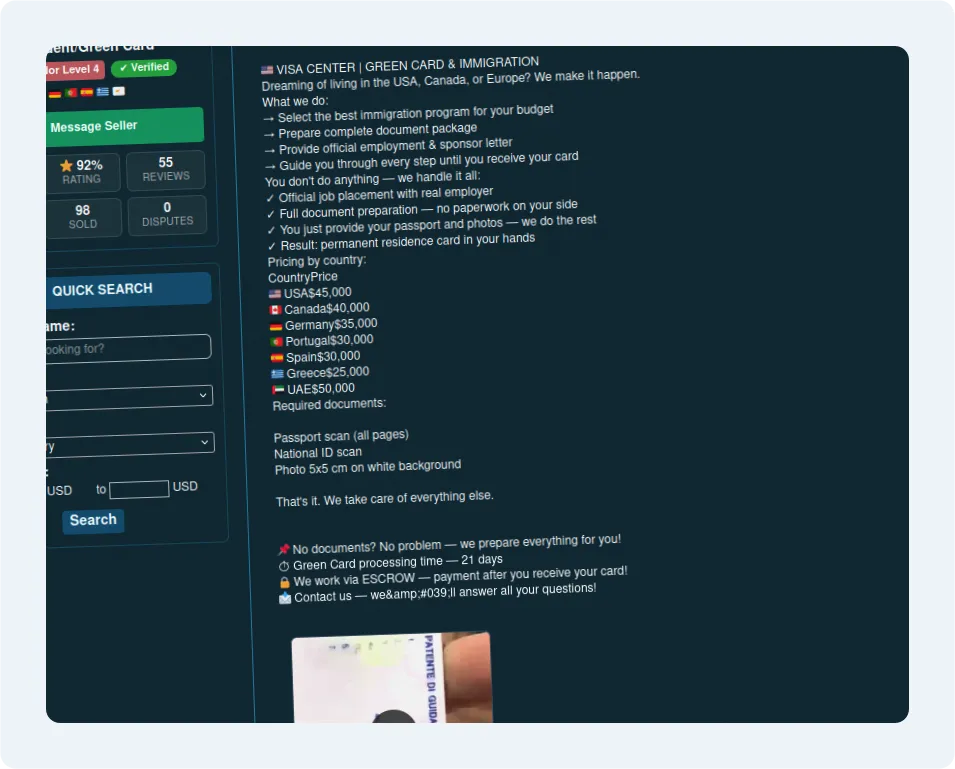
Every day, I watch thousands of searchers type phrases like "buy passport online" or look for green cards they can purchase, convinced they've found a shortcut to citizenship or a fresh start. Darknet vendors answer with polished storefronts, enthusiastic reviews, and listings priced from $500 to $2,000. They assure buyers that their products are "entered into official systems" and "guaranteed to clear any checkpoint." The entire presentation is theatre.
Whether you're after a diplomatic passport, pursuing a second passport, searching for a genuine passport, or attempting to purchase a green card, the financial reality stays constant. Any authentic document obtained through bribery starts at $30,000—and that's the baseline, not the ceiling. Anything beneath that threshold is pure pretence. Those $500 and $2,000 offers saturating darknet forums—marketed as novelty pieces or packaged with green card templates—amount to digital counterfeits at best, outright fraud at worst. Even legitimate corruption carries no assurance of delivery. You can confirm the real pricing here.
Understand Why $800 Prices Are Mathematically Impossible
Why would anyone trust adverts promising "genuine green cards" for $500 when the underlying economics make such figures absurd? The answer emerges once you consider what's actually required to funnel an authentic document through criminal channels. We're talking about far more than basement counterfeiters running inkjet printers. Claims that official passports sell for trivial sums reveal a fundamental ignorance of how clandestine production really operates.
An insider who breaches official infrastructure—passport registries, immigration databases, driver's licence archives—commands enormous fees precisely because discovery guarantees lengthy prison sentences. These operatives work inside government departments and fully grasp the brutal penalties for being caught. Biometric security raises the stakes further: modern passports and green cards incorporate fingerprint records, iris data, and digital images that must already exist in official systems before any physical card gets produced. Gaining access to the required hardware and government networks demands substantial capital investment.
Manufacturing the physical artefact itself requires blank stock from tightly controlled sources, such as the Government Publishing Office for U.S. documents. These materials face strict inventory tracking, and acquiring them involves expensive bribes. Entries must appear across multiple interconnected platforms—immigration files, border control systems, law enforcement databases—with each repository demanding separate payoffs and escalating exposure risk. Logistics, payments to middlemen, and counter-surveillance measures all inflate the final price tag. The distribution chain typically involves three to five intermediaries between the original corrupt official and the end buyer, with each tier extracting profit and pushing up the ultimate cost.
The numbers reveal the reality: genuine credentials obtained through underground channels run $30,000 to $80,000 for American passports or green cards. Countries with less robust database security see prices ranging from $5,000 to $15,000. Still nowhere near $500. Adverts suggesting you can purchase dark web passports for the cost of a second-hand smartphone defy elementary economic logic.
Compare Scammer Listings Against Black Market Reality
Comparing scammer listings to actual black market prices highlights the deception, as the genuine costs are significantly higher.
The black market price for an American passport book ranges from $35,000 to $80,000, while scammers list it online for $500–$1,500. A United States permanent resident card, or green card, can cost between $30,000 and $60,000 on the illicit market, but online fraudsters advertise it for $800–$2,000. For a European Union travel document from countries like Germany or France, the genuine underground cost is $25,000–$50,000, whereas online listings quote $600–$2,000. A state-issued driving permit from the United States has a black market value of $5,000–$15,000, yet scammers offer it for $200–$800. Travel documents from developing nations are priced at $5,000–$20,000 on the black market, with online scam prices ranging from $300 to $1,000. Lastly, a personal record containing a Social Security Number, when stolen, can be worth $1,000–$5,000, although scammers list it for just $50–$300.
When I encounter passport listings priced at these rock-bottom figures, I recognise three inevitable outcomes: receiving a laughably poor counterfeit that collapses under minimal scrutiny, obtaining merely a digital image file with zero physical product shipped, or experiencing complete radio silence after payment clears. Sellers operating at these price points possess neither connections to official government databases nor the advanced manufacturing capabilities authentic production demands. The fundamental economics make legitimate supply at such rates impossible—which is precisely why these offers always end in disappointment rather than delivery.
Recognise What Darknet Vendors Actually Sell
What do you actually receive when ordering identity papers from a darknet marketplace? In the most optimistic outcome, a physical counterfeit arrives—a laminated piece that might fool someone glancing casually. Yet these replicas are missing the protective elements found in authentic government-issued credentials: holographic layers, microscopic text, ink that reacts under ultraviolet light, and RFID chips containing encrypted information.
Run it through a border checkpoint or workplace background screening, and the lack of official records surfaces instantly. Immigration control systems, police databases, and biometric verification tools will return empty results. The credential simply doesn't appear in any governmental registry, making it worthless for any situation demanding proper authentication.
Often, though, nothing tangible materialises. Vendors dispatch a digital template or scanned photograph, insisting you handle printing yourself. Some provide instructions for DIY fabrication methods or claim to offer superior printing techniques. Many simply disappear once they've collected your cryptocurrency, leaving you with neither product nor any way to complain. Whether the advertisement promises citizenship documentation, residence permits, or any variation of fraudulent identity papers, the result stays consistent: lost funds and completely non-functional materials that won't survive even cursory inspection by trained personnel.
Calculate the True Cost Before Believing Any Offer
Before you entertain any pitch claiming you can acquire documents cheaply, run the numbers yourself. Think about what a government employee with database access actually risks: their entire career, their freedom, their retirement benefits. Would anyone accept $800 to jeopardise all that? Secure printing facilities maintain strict inventory controls on every blank form. Would an insider really sell that access for $1,500? Biometric systems demand specialised equipment and technical expertise. Would professionals with that knowledge work for $500?
Every stage of creating authentic documents through corrupt channels involves significant expense and danger. Officials taking bribes set their prices to match the risks they're assuming. Middlemen layer on their own fees. By the time any document reaches you as the final buyer, its cost reflects the accumulated danger and overhead carried by each person in the supply chain. An authentic green card obtained through illicit means begins at $30,000 because that figure represents the actual production expense.
When you encounter offers for diplomatic or second passports at a tiny fraction of that amount, you're not discovering a deal. You're staring at a fraud operation built to prey on urgent need. The sellers understand these economics perfectly well. They're banking on you never working through the calculations yourself.
Face the Economics Before Searching
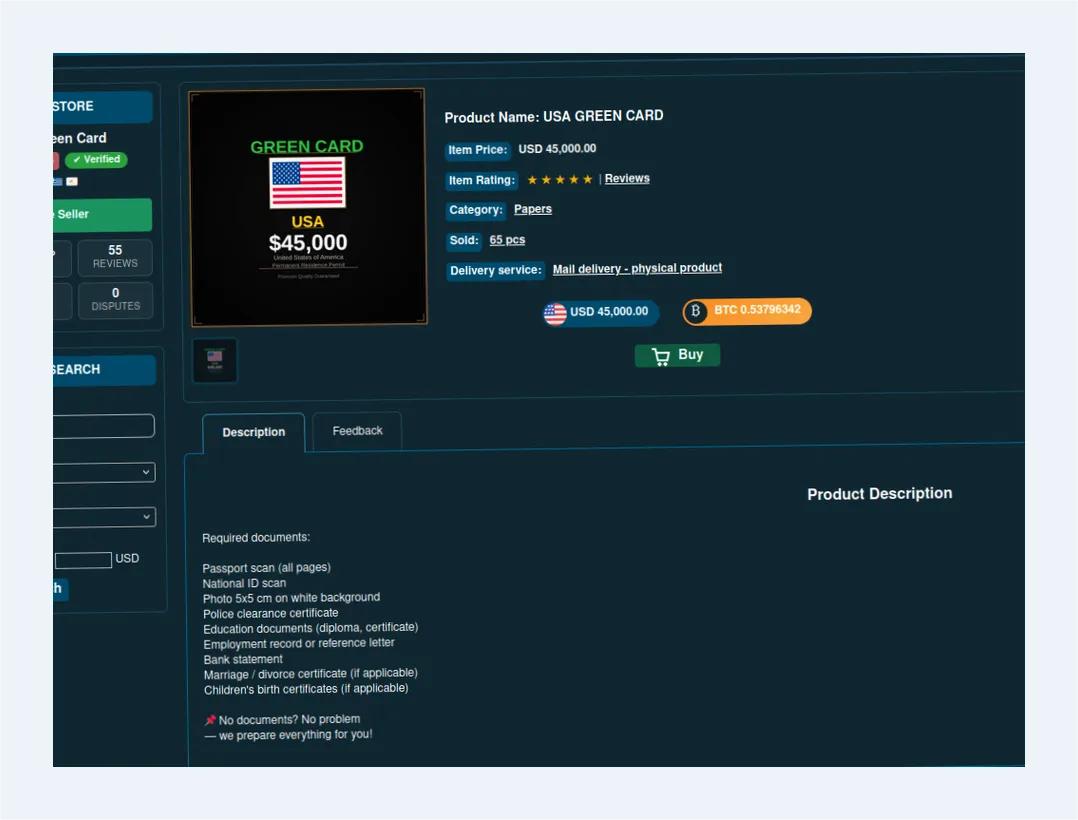
Every advert offering documents at suspiciously low prices shares identical characteristics: polished websites, enticing guarantees, and costs that appear almost affordable. Yet the chasm between advertised rates and actual market realities exposes the deception immediately. Templates obtained from hidden corners of the internet will collapse under the first authentication procedure. Novelty documents purchased for $600 cannot facilitate border crossings. So-called registered credentials acquired for $1,200 have zero presence in official databases.
Why such a gap? Because genuine corruption operates at vastly higher price points. Documents procured through illicit channels demand tens of thousands precisely because bribing officials, penetrating secure production facilities, and inserting records into interconnected verification systems carries enormous expense. Anything priced beneath that floor represents either a useless replica or complete theft of your funds. Before entering search terms like "buy genuine passport" or "fake green card for sale," grasp this fundamental truth: budget options invariably drain your wallet whilst delivering nothing remotely functional. The economics dictate that shortcuts don't exist at bargain rates.