Can automated teller machines successfully identify counterfeit bills? Derek H., a 29-year-old from Denver, wagered his future on the assumption they could not. His strategy seemed straightforward: purchase high-grade forged notes via darknet channels, feed them into ATM deposit slots, and transform fraudulent paper into legitimate electronic balances. The logic carried surface appeal—machines process transactions without the careful examination a human bank employee might provide. However, within 24 hours of his first deposit in January 2025, his account was frozen, culminating in his apprehension by U.S. Secret Service agents.
The clandestine vendor marketed these counterfeits as "superdollar quality"—reproductions equipped with functioning UV features, magnetic ink properties, and watermarks engineered to fool automated verification systems. Derek remitted $1,200 in cryptocurrency to obtain 40 counterfeit $100 bills displaying 2009 series indicators, convinced the integrated security elements would outsmart banking machinery. His fundamental error involved underestimating the multi-layered surveillance protocols tracking each transaction, systems purpose-built to catch precisely these operations. What seemed like a weakness in automated processing was instead a heavily monitored control point where forgery attempts consistently fail.
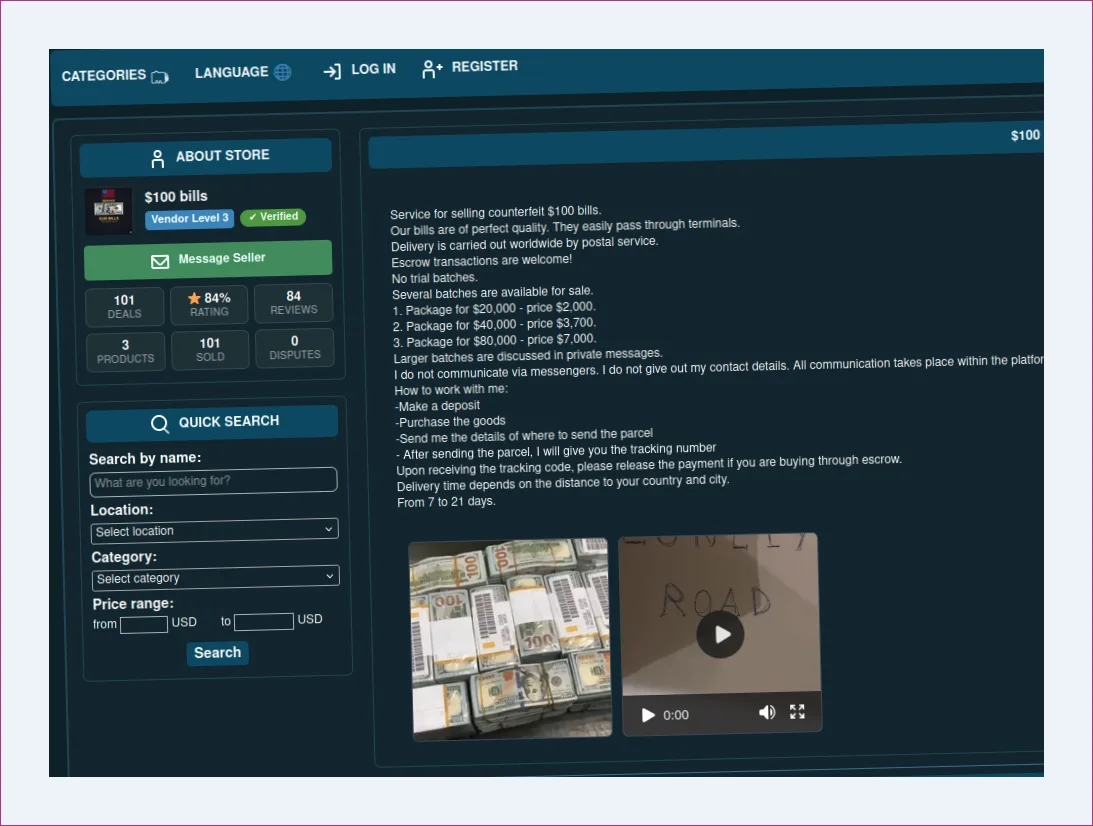
Derek sourced his counterfeit notes from the website where the purchase was made, a darknet marketplace promising undetectable forgeries.
Understand How ATM Fraud Detection Actually Operates
Derek's fundamental mistake lay in believing that machine acceptance guaranteed fraud success. Deposit-capable ATMs immediately scan inserted cash for magnetic ink signatures, infrared markers, and security thread positioning—features authentic banknotes contain but even premium fake 100 dollar note copies fail to reproduce flawlessly. His initial 800 dollar deposits cleared first-level sensors, yet this clearance simply meant transactions entered processing queues rather than evading scrutiny altogether.
Secondary verification begins 12 to 48 hours after each cash deposit. Banks deploy human examiners or sophisticated optical equipment to re-inspect flagged currency. Derek purchased counterfeits at 30 dollars per bill—a premium darknet rate—securing forgeries adequate for initial sensor approval but insufficiently robust for subsequent examination. His third ATM outright rejected one note, whilst the fourth machine accepted the deposit but flagged it for manual inspection, establishing the digital evidence chain that ultimately exposed his scheme. This layered detection architecture ensures that even technically proficient counterfeits rarely survive the complete verification process banks employ to protect their systems.
Recognise the Digital Audit Trail Left Behind
Why would anyone assume ATM transactions provide cover when each deposit generates a timestamped, geotagged record linked directly to a verified account? Derek operated through his personal bank account—an account connected to his identification papers, residential address, and complete financial history. Once the bank's security division spotted counterfeit $20 notes and hundreds within his deposit batch, they held a comprehensive file: every ATM he accessed, precise timing for each visit, and video recordings from all locations.
Contemporary banking systems scrutinise cash deposits with particular intensity because they constitute one of the last remaining pathways for inserting physical forgeries into electronic networks. Purchasing fake 20 dollar notes or higher values and then attempting to deposit them establishes a permanent connection between the physical fraud and your electronic profile. Derek's account suspension materialised within 16 hours following his fourth deposit, illustrating how swiftly financial institutions can identify suspicious activity patterns spanning multiple terminals.
Examine the Intersection of Federal Jurisdiction and Counterfeiting
What distinguishes counterfeiting from ordinary financial fraud? The U.S. Secret Service—originally created to combat currency forgery—maintains exclusive jurisdiction over these cases, treating them with severity that often surprises first-time offenders. Derek's purchase from the fake money darknet marketplace constituted one federal offence; his four deposit attempts created four additional counts of uttering counterfeit currency.
The penalties escalate because counterfeiting threatens monetary system integrity rather than merely defrauding individual institutions. Prosecutors view schemes involving realistic fake money australia vendors or domestic counterfeiters with equal gravity, as the crime attacks the currency itself. Derek faced charges carrying up to 20 years imprisonment—not because he successfully stole $800, but because he introduced forged instruments into the banking system. Before considering whether prop money for sale nearby might serve any scheme, understand that the moment you attempt to pass it as genuine, you cross from possession into active counterfeiting under federal law.
Trace the Vendor's False Promises Against Technical Reality
The darknet seller guaranteed notes with working security features—UV strips, magnetic properties, watermarks visible under light. Yet genuine $100 bills contain over a dozen anti-counterfeiting elements, many proprietary and impossible to replicate without Treasury Department resources. The fake 100 dollar note Derek received likely possessed three or four convincing features whilst lacking subtle thread positioning, correct paper composition, or precise colour-shifting ink that sophisticated scanners detect.
Vendors advertising buy fake dollars services exploit buyers' ignorance of detection technology's actual capabilities. They sell the fantasy that a $30 counterfeit can fool systems designed by engineers who anticipate every known forgery technique. Derek's "superdollars" fooled initial sensors but failed backend analysis—exactly the outcome security experts design for, creating a false sense of success that leads to arrest rather than escape.
Why the Scheme Was Doomed From Conception
Derek's scheme collapsed because he misunderstood the fundamental architecture of modern banking fraud prevention. ATMs serve as the first checkpoint in a multi-layered verification system, not the sole arbiter of authenticity. His assumption that machine acceptance meant successful fraud ignored the human and computational review that follows every cash deposit, particularly those involving high-denomination notes.
The case illustrates why counterfeiting remains among the most reliably prosecuted financial crimes. Every step—from purchasing on a darknet marketplace to depositing at geolocated ATMs—creates evidence that investigators can trace backward. Derek's cryptocurrency payment, his account details, and surveillance footage formed an unbreakable chain linking him to the physical counterfeits. The appeal of turning paper into digital currency evaporates when you recognise that the paper itself becomes the evidence.
Before anyone considers whether sophisticated forgeries might bypass detection, examine the prosecutorial record: the Secret Service boasts conviction rates exceeding 95% in counterfeiting cases. The technology gap between genuine currency and even the best fakes remains insurmountable for non-state actors, and the digital infrastructure surrounding every transaction ensures that attempts leave permanent, traceable records.