I've examined countless fraud cases over the years, but Mark T.'s situation stands out for one reason: the speed at which it collapsed. In November 2024, this 34-year-old Tampa Bay man thought he'd discovered an easy route to fast cash. He transferred $480 in cryptocurrency to a darknet vendor, receiving six cloned debit cards complete with PINs. Three separate ATM transactions netted him $4,200 before his fourth attempt brought everything crashing down.
Why does this particular incident warrant attention? Not because card cloning represents anything new — it's been around for decades. Rather, it's the investigative chain that connected an apparently anonymous online purchase to federal charges in under a month. Mark's journey from buyer to convicted criminal illustrates exactly why ATM surveillance has become law enforcement's most reliable tool against payment fraud, and why even purportedly untraceable cryptocurrency transactions can't shield criminals from basic investigative procedures.
I'm not here to teach you how to spot skimming equipment or check card readers at filling stations. My purpose is to examine a failed withdrawal operation — identifying the mistakes that turned an attempted crime into a textbook prosecution example.
Why Did Mark Believe He Could Succeed?
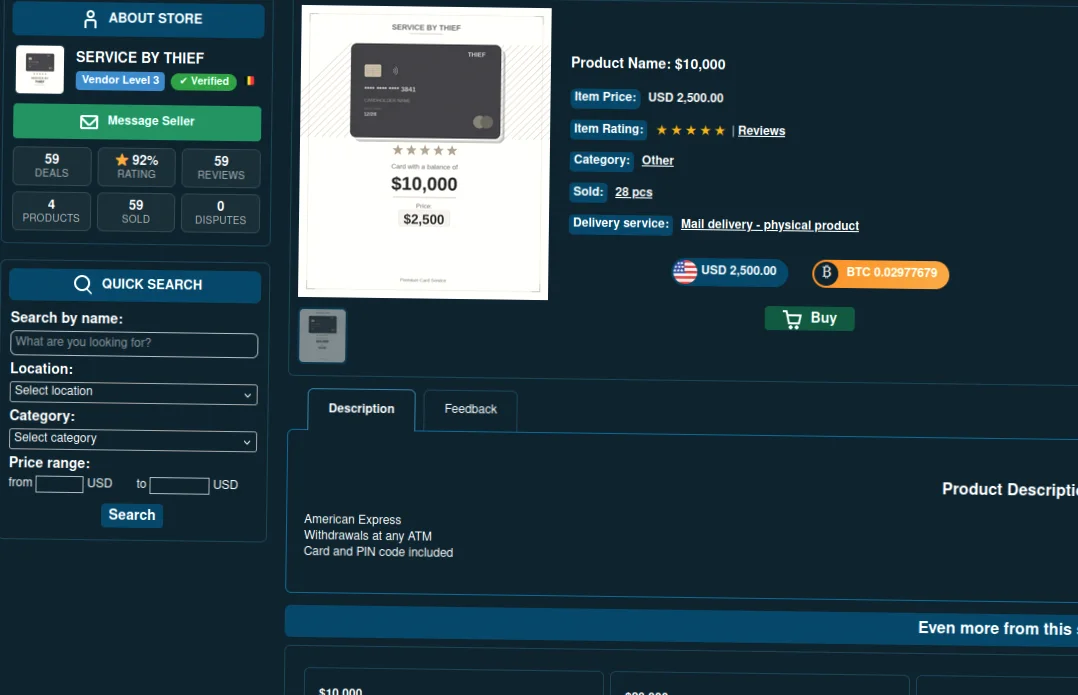
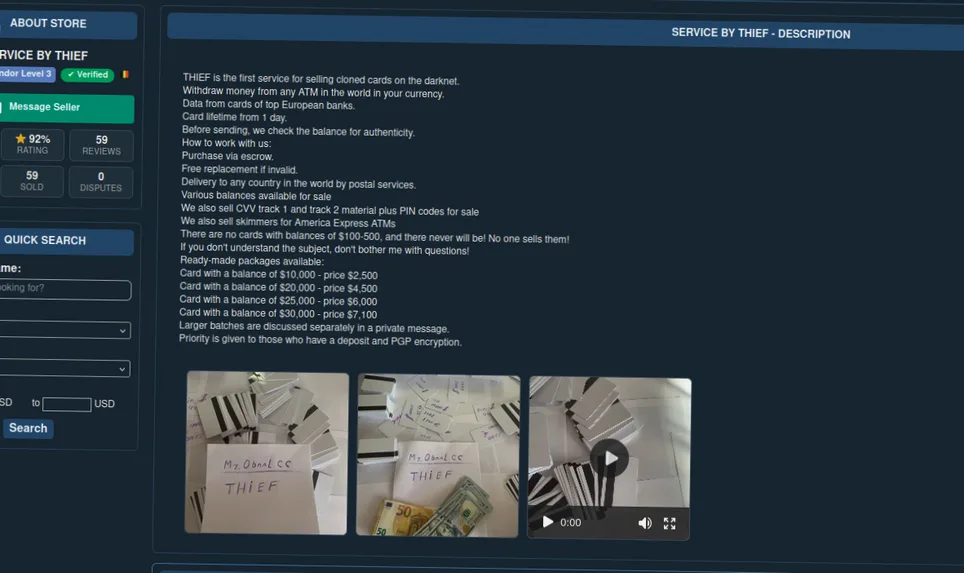
The clandestine marketplace Mark patronised presented itself as a dependable supplier of illicit payment instruments. Sellers hawking cloned cards — a persistent subject throughout carding forums, dark web circles, and even cloned cards reddit threads — offered pre-manufactured financial tools prepared for instant deployment. Rather than raw information demanding technical skill to weaponise, these products materialised as physical plastic cards embedded with pilfered magnetic stripe data, delivered covertly via standard postal services.
Mark's vendor furnished a standard package: unprinted cards stamped with authentic cardholder information such as names, validity dates, and account identifiers, subsequently encoded with track 1 and track 2 data harvested through credit card skimming devices. PIN sequences came from overlay keypads or miniature cameras installed beside ATM pin pads — although technology designed to detect credit card skimming device hardware does exist, most consumers never think to inspect terminals. Each card Mark obtained linked directly to a genuine victim whose financial particulars had been compromised, likely via shimmer devices hidden within card readers or data breaches at payment processing firms.
In Mark's assessment, the whole operation seemed bulletproof. He remitted payment through Monero, a cryptocurrency designed specifically to obscure transaction trails. His parcel materialised without incident. For an individual with a clean criminal history, the venture appeared virtually risk-free — a digital transgression producing physical rewards with apparently no connection bridging the two domains. That assumption proved catastrophically wrong.
What Happened During Those Critical 72 Hours?
Mark's initial trio of ATM transactions proceeded without incident. He extracted amounts that appeared ordinary — not the ceiling that would immediately alert fraud systems, but enough to justify his $480 outlay. Before visiting his next machine in a Tampa Bay area suburb, he'd already accumulated $4,200. That subsequent transaction netted him an additional $700.
He failed to appreciate that contemporary ATMs operate as thorough evidence-gathering apparatus. Each terminal captures video at 1080p, frequently equipped with infrared for dimly lit environments. Multiple units house dual cameras: one obvious lens directed at the user's face, plus a concealed second camera recording from an alternate vantage point. Transaction records timestamp each interaction to the precise second, logging card details, requested sum, machine GPS coordinates, and network response data.
At that particular suburban terminal, Mark committed a catastrophic mistake: he appeared completely undisguised. No face covering, no tinted eyewear, no hat brim lowered over his features. The lens recorded twenty-three seconds of unobstructed facial imagery — complete profile, adequately illuminated, zero visual barriers. That brief recording segment formed the foundation of his eventual prosecution. Regardless of how flawlessly he'd managed every other security measure, those twenty-three seconds alone provided sufficient material for identification and conviction.
Concurrently, individuals in Florida, Georgia, and North Carolina discovered unauthorised debits from their accounts. Each person reported the fraud to their financial institution. Banks immediately cancelled the compromised cards and transmitted the incident details to early warning fraud networks — automated systems designed to detect suspicious activity patterns spanning multiple institutions. Within several days, detection algorithms recognised the connecting element: numerous duplicated cards accessing cash machines across state boundaries during a concentrated period.
How Did Investigators Build the Case So Quickly?
The investigation timeline reveals how rapidly modern forensic techniques close the loop on fraud. By the third day, automated anti-fraud algorithms had already detected the pattern. Banks no longer rely on manual review to spot anomalies — machine learning systems trained on millions of legitimate transactions flag outliers in real time. When cloned cards from the same batch surface across multiple states within 48 hours, the escalation is automatic.
Within five days, federal agents from the U.S. Secret Service had taken over, exercising their authority over crimes involving financial access devices. Analysts immediately requested complete ATM logs and camera recordings from every location tied to the fraudulent cash-outs. Video from Mark's fourth transaction delivered the critical breakthrough: an unobstructed facial image suitable for database comparison.
Florida's Department of Public Safety archives driver's licence photographs for every registered resident. Facial recognition technology matched the ATM footage against this repository and identified Mark T., age 34, with no prior convictions and a residential address near Tampa Bay. Geolocation analysis revealed that every cash withdrawal had taken place within a 40-mile zone centred on his residence — a concentration so tight it effectively mapped his daily movements.
By the twelfth day, investigators had obtained authorisation to examine digital footprints. Internet service provider records disclosed Tor network activity during the hours that aligned with the darknet purchase window. More significantly, Mark had acquired his Monero via a centralised platform that enforced KYC verification — passport scans and selfie authentication. A court order forced the platform to release his identity and full transaction ledger. While Monero itself resists tracing, the regulated entry point into cryptocurrency created an indelible record linking Mark's legal identity to his darknet payment.
The search executed on day fourteen produced physical proof that eliminated any remaining doubt: six unembossed plastic cards, a magnetic stripe encoding device designed for card cloning, a laptop retaining Tor Browser artefacts and evidence of marketplace access, $3,200 in cash whose denominations precisely mirrored ATM dispensation patterns, and shipping remnants from the vendor's parcel. Each item reinforced the chain connecting digital anonymity to physical consequence.
Could Any Card Skimmer Protection Have Prevented This?
This question misses the central point. Mark wasn't placing skimmers on ATMs — he was exploiting data that others had already stolen. The original cardholders might have avoided compromise through vigilant inspection, but once Mark bought those tracks, the theft was complete. Even so, knowing what to look for at card readers remains vital for stopping these crimes before they start.
Anyone approaching an ATM should examine several telltale indicators. Some banks fit physical shields over insertion slots to block overlay devices, though skilled thieves routinely bypass these barriers. Visual checks prove more dependable: does the slot appear identical to those on adjacent machines? Does it shift when you pull gently? Do you notice odd seams or components that don't align properly? Law enforcement publishes photographs of confiscated devices, revealing just how advanced these tools have become — many are almost impossible for ordinary users to recognise.
The keypad warrants just as much attention. Fake keypads that record PIN entries often sit noticeably higher than the genuine surface. Press each button — it should respond firmly and uniformly. A mushy or unusually thick pad might hide a recording mechanism underneath. Scan the area near the screen for tiny camera lenses pointed at your fingers. Security forums and dedicated online communities frequently post images of discovered gadgets, which help train people to notice irregularities.
Beyond physical inspection, some banks now provide virtual card numbers for ATM use or instant alerts for each transaction. These measures won't prevent a device from capturing your magnetic stripe, but they shrink the gap between compromise and discovery. The sooner a cardholder flags suspicious activity, the faster the institution can freeze the account — precisely what happened with two of Mark's six cards before he managed to withdraw anything. That rapid response cut his potential haul and left a trail investigators could follow straight to him.
What Were Mark's Critical Operational Failures?
I've reviewed countless fraud investigations, and Mark's downfall followed a script I've seen play out dozens of times. His errors weren't sophisticated oversights—they were basic lapses in operational discipline that any competent investigator would exploit.
Consider the geographic footprint first. Every single ATM he targeted sat within 40 miles of where he actually lived. Fraud detection systems are programmed to catch exactly this behaviour because authentic cardholders don't typically execute multiple quick cash-outs clustered around a single location whilst simultaneously using their genuine cards nearby. Spreading transactions across different cities or extending them over several months might have delayed automated alerts, although recorded surveillance footage would have eventually revealed his identity regardless.
Next, he made no effort to obscure his appearance. I'm not advocating for disguises at cash machines, but you must understand that contemporary camera systems make facial recognition almost effortless. Law enforcement maintains extensive photograph databases from driving licences, passport files, and increasingly from social networking platforms. One sharp image is enough to eliminate any pretence of anonymity.
The centralised exchange presented another vulnerability. Privacy-oriented digital currencies like Monero do provide transactional obscurity, but that advantage disappears entirely at conversion points. Purchasing Monero through a platform requiring passport verification creates an indelible link between your actual identity and that specific acquisition. Investigators bypass blockchain analysis entirely—they simply demonstrate you acquired the currency on dates matching darknet purchases.
Physical evidence compounded these digital missteps. The magnetic stripe encoding device, blank plastic cards, a laptop containing marketplace navigation records, and cash in denominations identical to ATM distributions all remained in his residence until officers executed their warrant. Forensic specialists routinely restore erased files, reconstruct browser activity, and extract Tor usage details from system logs. Material objects amplify electronic footprints.
Perhaps most damaging was the condensed timeframe. Acquiring Monero, ordering card data, accepting delivery, and executing withdrawals all transpired within a fortnight. This rapid sequence enabled investigators to connect events with minimal effort. When purchase timestamps, shipping confirmations, and cash machine transactions align within such a narrow window, the accumulated circumstantial proof becomes nearly irrefutable.
What Do the Numbers Tell Us About Risk and Reward?
Breaking down the financials of Mark's operation reveals the inherent flaws that lead to its downfall, as the numbers starkly illustrate the unsustainable nature of such endeavors:
| Service Description | Price Range or Amount |
|---|---|
| Total fines and restitution ordered by the court | $22,000 |
| Total amount withdrawn from ATMs | $4,900 |
| Total proceeds after deducting card cost | $4,420 |
| Cost of acquiring cloned cards (six units) | $480 |
| Length of federal prison sentence imposed | 60 months |
| Days between the first withdrawal and arrest | 15 |
| Number of functional cloned cards before being blocked | 4 of 6 |
| Duration of supervised release after prison | 3 years |
At first glance, walking away with $4,420 after two weeks appears lucrative. Yet when we account for the consequences—60 months behind bars, financial obligations exceeding his haul by more than fourfold—the equation turns disastrous. Federal custody doesn't permit early release for good conduct the way many state systems do, so Mark faces the full sentence without reduction. His restitution and fines total $22,000, dwarfing what he actually obtained.
Even absent his capture, the model couldn't scale. Financial institutions had already frozen 4 of 6 cards before he touched them, signalling that detection algorithms were tightening the net. A second purchasing round would have triggered even swifter countermeasures as pattern-matching systems flagged similar activity.
Consider the daily mathematics: Mark averaged roughly $295 per day throughout his brief criminal run. Federal prison labour pays between $0.12 and $0.40 hourly—translating to about $2.40 daily. Over 60 months, the opportunity cost becomes staggering: five years without legitimate career progression, without building skills, without maintaining a clean record. The long-term economic damage extends far beyond the immediate penalties. Employers routinely reject applicants with fraud convictions, particularly for positions involving financial responsibility. Housing applications, professional licences, even volunteer opportunities become complicated.
The arithmetic makes clear what intuition suggests: this path offers no rational upside, only compounding losses that multiply with each passing year.
How Do Anti-Fraud Systems Actually Catch These Patterns?
Banks don't rely on manual review to spot cloned cards — the transaction volumes make human oversight impossible. Instead, machine learning models trained on historical fraud patterns analyse every transaction in real time, assigning risk scores based on dozens of variables.
Geographic velocity triggers immediate flags. If your card appears in London at 2pm and Miami at 3pm, the system knows that's physically impossible and blocks the transaction. Mark's case involved a subtler pattern: multiple cards from different account holders all hitting ATMs in the same geographic cluster within hours of each other. This signature indicates a batch of cloned cards being cashed out by a single operator.
Transaction behaviour analysis examines how the card is used. Legitimate cardholders exhibit predictable patterns — regular merchants, consistent withdrawal amounts, typical times of day. When a card that normally makes supermarket purchases suddenly withdraws cash at 3am from an ATM in a different state, the anomaly score spikes. Mark's victims likely had established usage patterns that made the unauthorised withdrawals stand out immediately.
Cross-institution data sharing amplifies detection speed. Early fraud warning systems pool information across banks, so when multiple institutions report similar fraud patterns simultaneously, the network identifies the common thread. This is why Mark's use of cards from victims in three different states actually accelerated detection rather than obscuring it — the pattern became visible across the network.
What many criminals underestimate is how these systems learn. Every successful fraud case feeds back into the training data, making the models more sensitive to similar patterns in future. The techniques that worked five years ago now trigger instant blocks because the algorithms have seen them before.
What Happened in Court?
In March 2025, Mark entered a guilty plea to a pair of federal charges: breaches of 18 U.S.C. § 1029, which governs fraudulent access-device activity, and violations of 18 U.S.C. § 1957, which addresses laundering proceeds from specified unlawful activity. Prosecutors in the Middle District of Florida laid out their case, and the judge imposed a prison term of 60 months followed by 36 months of supervised release.
Why did the court stop at that figure when financial crimes carry such weight? The answer lies in Mark's role at the lowest rung of the operation—he merely extracted cash from ATMs rather than designing skimmers or administering the clandestine marketplace. Those who harvested card data, operated the illicit platform, and produced the counterfeits have mostly escaped detection. This pattern recurs across fraud prosecutions: the person who physically collects stolen money and appears on surveillance footage shoulders the harshest legal burden, while coordinators higher in the chain retain their anonymity and sidestep prosecution.
The financial penalty of $22,000 covers both court-imposed fines and restitution to the three account holders whose balances Mark depleted. Supervised release after prison demands compliance with several conditions: scheduled appointments with a probation officer, substance testing, consistent employment, and restrictions on internet use and financial behaviour. Violating any term can trigger a return to custody.
Federal sentencing guidelines consider the amount stolen and the offender's prior record. Mark's lack of previous convictions likely reduced his sentence—a defendant with earlier offences would have faced substantially longer incarceration. His guilty plea also spared the government a trial, a concession prosecutors generally reward with more lenient recommendations. Had he fought the charges and lost at trial, the sentence could have stretched to 120 months or more.
What Does This Case Teach Us About Modern Fraud?
Mark T.'s case illustrates a fundamental truth about modern fraud: digital anonymity evaporates the moment criminal operations enter the physical world. Darknet marketplaces, privacy coins, and encrypted communications offer substantial cover — until you stand in front of an ATM camera withdrawing cash. At that moment, even sophisticated operational security becomes irrelevant if you've neglected basic precautions.
From a security professional's standpoint, this incident highlights the effectiveness of layered defence strategies. Fraud detection algorithms, ATM surveillance systems, transaction logs, and inter-bank communication networks all functioned exactly as designed. No single element would have been sufficient alone, but together they created an evidence chain linking a darknet purchase to federal charges within fifteen days. The system worked not merely through cutting-edge technology, but because physical monitoring and digital forensics complemented each other.
Consumers looking for advice on checking ATMs for skimming devices or implementing strong card skimming protection can draw a simpler lesson: vigilance during transactions serves as your first line of defence. Inspect cash machines before inserting your card, monitor account activity daily, and report suspicious transactions immediately. Faster victim reporting reduces the window fraudsters have to operate. In Mark's case, two of his six purchases had already been blocked by the time he attempted withdrawals — a direct result of victim notifications and rapid banking intervention. Those two blocked purchases demonstrate effective card skimming protector mechanisms at work, even after the initial breach. The marketplace where he acquired the cards continues operating today, showing that while individual criminals face consequences, the underlying infrastructure persists across darknet ecosystems.
The website where the purchase was made continues operating, serving as a reminder that whilst individual criminals face justice, the infrastructure enabling these crimes persists across darknet platforms.
FAQ
How do ATM cameras help catch criminals using cloned cards?
Modern ATMs record high-resolution video of every customer, timestamped to match transaction logs. When fraud is reported, investigators retrieve footage corresponding to the unauthorised withdrawal time, then use facial recognition to match the image against driver's licence databases. This process often identifies suspects within days.
Can privacy cryptocurrencies like Monero truly protect buyer identity?
Monero transactions themselves are difficult to trace, but the entry and exit points remain vulnerable. Most buyers use centralised exchanges requiring passport verification to purchase Monero, creating a permanent record linking their real identity to the purchase date and amount. Investigators don't need to follow the blockchain — they just prove you bought the currency when the darknet purchase occurred.
Why do card fraud cases result in federal rather than state charges?
The U.S. Secret Service holds jurisdiction over crimes involving access devices and financial institution fraud under federal statutes. When fraud crosses state lines or involves interstate commerce — as most card cloning operations do — federal prosecutors take the case. Federal sentences typically carry longer prison terms and lack the early release options common in state systems.
How quickly do banks detect patterns from cloned card batches?
Machine learning systems can flag suspicious patterns within hours. When multiple cards from different account holders all make ATM withdrawals in the same geographic area within a compressed timeframe, algorithms recognise this as a batch cash-out operation. The systems automatically escalate to human investigators, who can pull video footage and begin identification within days.